THE CENTRAL NERVOUS SYSTEM FOR BUSINESS
Your entire
operation.
One living system.
People. Production. Possibility.
Connected by ATLAS. Understood by Quill.
A NEW OPERATING PERSPECTIVE
Your business moves.
Your system should, too.
A job changes. A machine stops.
A customer needs an answer.
Everything is connected.
ATLAS brings the floor, execution, business, and customer into one operational picture. Every meaningful event becomes part of a shared record, so the next decision starts with what actually happened.
One system of record. Intelligence in context.
A business that can see itself clearly.
See the floor.
Machines, queues, materials, and movement.
Trace the work.
Every job, event, inspection, and handoff.
Connect the business.
Orders, inventory, purchasing, and cash flow.
Know the customer.
Accounts, quotes, history, and opportunity.
MES foundation deployed at Cyclone Bolt. Broader capabilities follow the phased roadmap.
INSIDE ATLAS
Clarity at
every altitude.
From the next job to the next decision.
Explore how one shared record becomes
the right view for the person using it.
 ATLASOperations overview
Know where the day stands.
A shared operational picture of jobs, flow, and exceptions. Select a department to see the work moving through it.
MEET THE INTELLIGENCE INSIDE
Every ATLAS
needs its Quill.
The voice of the system.
The watch that never sleeps.
Ask a question in plain language. Get an answer tied to the records behind it. Quill is designed to connect what happened, why it matters, and what needs your attention.
THE ARCHITECTURE OF BETTER DECISIONS
One event.
A business that responds.
A machine event becomes context, then insight.
ATLAS is designed to close the distance
between the floor and the decision.
CNC-02 starts job WO-4821.
A machine, an operator, and a timestamp. The system begins with what actually happened.
The advantage
compounds.
Run the operation. Capture the events. Improve the next decision. Each cycle adds context for the one that follows.

FACTORY DIGITAL TWIN / PLANNED CAPABILITY
A living mirror
of your operation.
See the physical world in operational context.
Machines. People. Jobs. Every connection matters.
BUILT ON SOMETHING STRONGER
Correct before
clever.
Intelligence is only useful when the underlying record can be trusted. These are the principles ATLAS is built around.
01Reality is the reference.
Physical inventory is finite. Machines have constraints. Exceptions happen. If the system disagrees with reality, the system needs to change.
02Every state is explicit.
Defined lifecycles, timestamped transitions, and accountable actors. “Mostly done” is not an operational state.
03History stays intact.
Events are recorded, never overwritten. Corrections add context while preserving the original record.
04Trust comes before automation.
Clean data and clear controls come first. Intelligence sits on top of a reliable system of record.
05One truth. Many views.
Operators, quality, warehouse, sales, and leadership work from the same facts, presented for the decision each person needs to make.
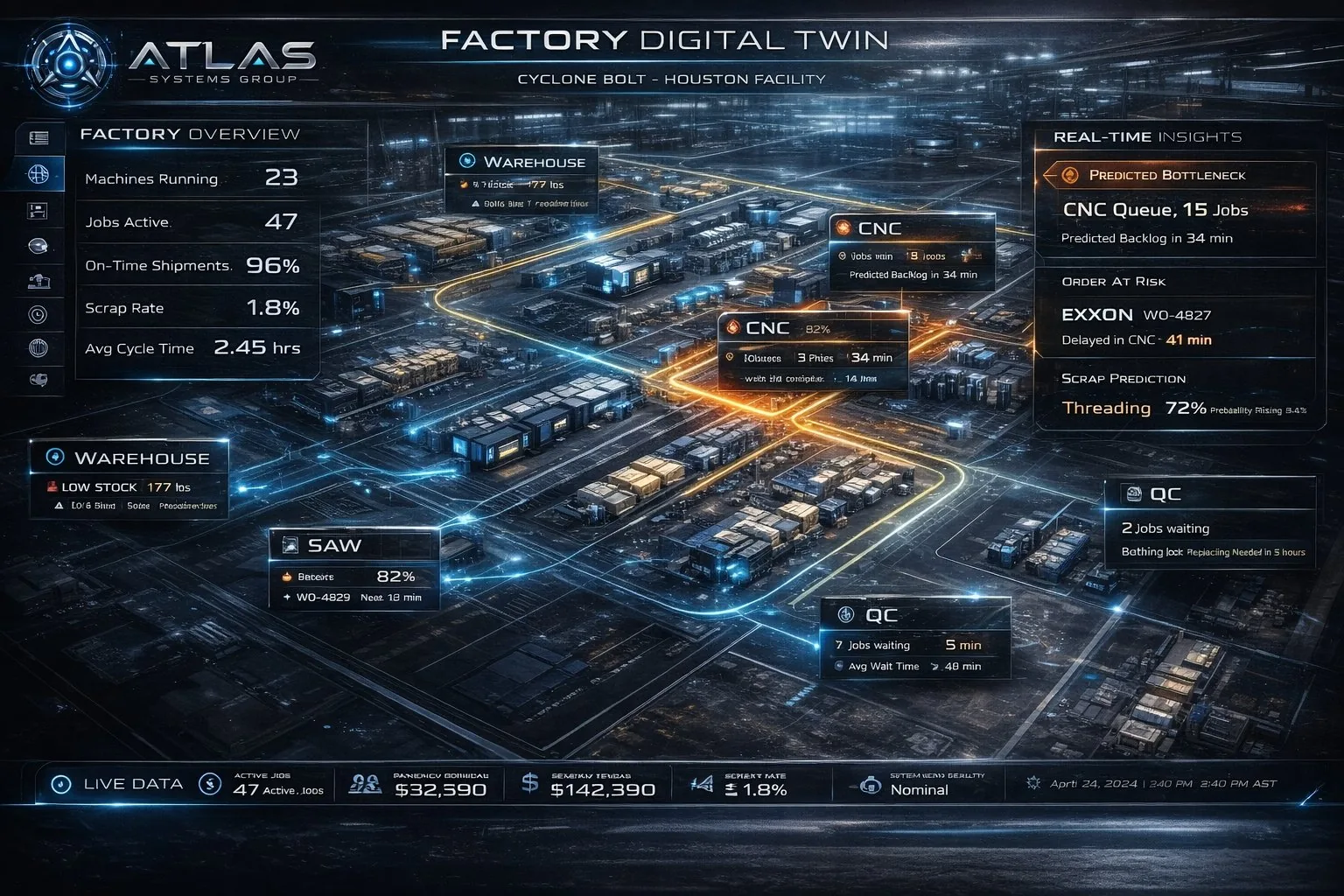 CYCLONE BOLT / DIGITAL TWIN CONCEPT
CYCLONE BOLT / CUSTOMER ZERO
Built where
work happens.
ATLAS began inside a precision fastener manufacturer in Houston. Real jobs. Real machines. Real consequences when the information is wrong.
The MES foundation is deployed at Cyclone Bolt. The floor is where the system earns trust, one event at a time.
Cyclone Bolt and Atlas Systems Group are separate legal entities. ATLAS IP is owned by Atlas Systems Group; Cyclone is a licensee and Customer Zero.
A DELIBERATE ROADMAP
Foundation first.
Intelligence next.
Eight phases. Each advances when the work
before it is trusted and used daily.
Explore the direction.
MES foundation
Capture events, states, and accountable actors. Establish the operational record that everything else will build on.
On the horizon: the Trust Layer FUTURE CAPABILITY
A planned integrity layer for Material Test Reports: sealed at QC release, checked for alteration, and tied to their provenance. This concept supplements existing physical record retention. It does not change regulatory or audit requirements without approval from the relevant certifying body.
Request the Trust Layer briefTHE NEXT CHAPTER
Build what
comes next.
With ATLAS.
We’re selectively opening conversations with operators, design partners, and people who see where industrial software needs to go.
Tell us what your operation needs.
We’ll start there.
Bring us your hardest operational problem.
Help shape ATLAS through the realities of your business.
A different perspective on industrial software.
Tell us about your firm and what you want to explore.
Start a conversation.
Partnerships, press, questions, or a new perspective.
Your details are used to respond to this inquiry.
In this review version, submission opens the ATLAS website to securely send your inquiry.